My Dog Kept Eating Grass — A Daily Probiotic Scoop Changed Everything
When Cooper started eating grass every single walk, I figured it was just a dog thing. Then came the gas, the gurgling stomach, and the stools that never looked right. After months of vet visits and diet changes, I tried something different — a daily probiotic powder with eight targeted strains. This is what happened.
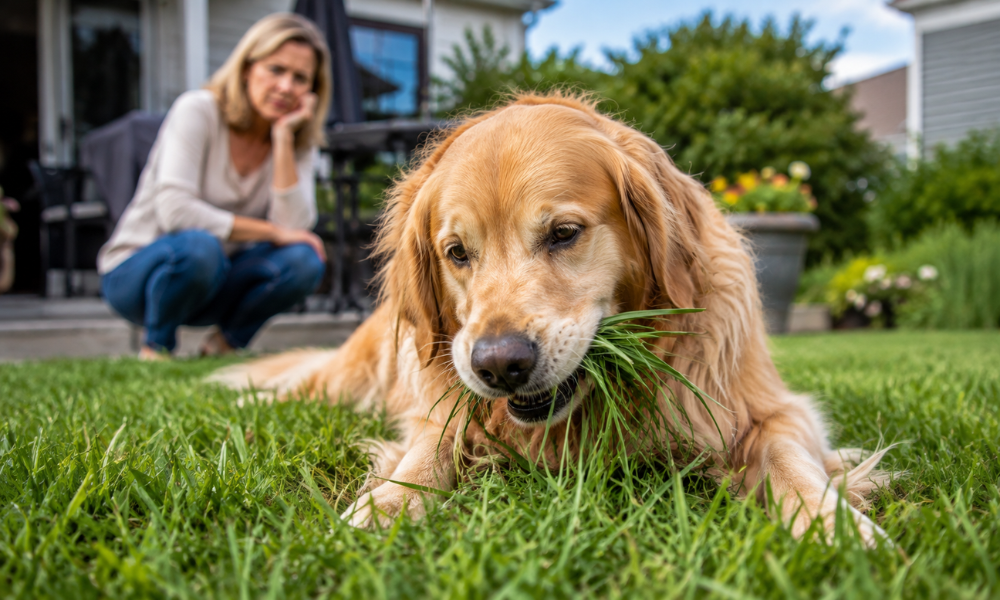
Every dog owner knows the scene. Your dog is out in the yard, head down, tearing at the grass like it is a meal. Then comes the gulping, the gas, the loose stools — and yet another expensive bag of prescription food that changes nothing.
At first, I blamed the food. I switched brands three times, tried grain-free, tried limited ingredient. Nothing helped. Cooper — my seven-year-old Lab mix — still had the same gurgling stomach, the same inconsistent stools, the same grass-eating habit that had me worried something was seriously wrong.
Our vet ran bloodwork, checked for parasites, even did an ultrasound. Everything came back normal. But she said something that changed my perspective entirely: “His gut flora might be out of balance. You can feed him the best food in the world, but if the bacteria in his gut cannot process it properly, the symptoms will persist. There is solid research now on canine-specific probiotic strains.”
That conversation sent me down a research path I was not expecting — into the world of canine gut health and the specific bacterial strains that support healthy digestion in dogs.
When I started researching the canine microbiome, I was surprised by how much published science exists on probiotic supplementation for dogs. The connection between gut bacteria and digestive comfort is far more established than I realized.
Three categories of probiotic function kept coming up:
Digestive support. Certain Lactobacillus and Bifidobacterium strains have been studied for their ability to support healthy digestion in dogs. They help break down food more efficiently and support the production of short-chain fatty acids that nourish the gut lining. Published research has explored how these bacteria contribute to firmer stools and reduced gas.
Microbial balance. Saccharomyces boulardii is a beneficial yeast — not a bacteria — that has been researched extensively for its role in maintaining microbial balance. Unlike bacterial probiotics, it is naturally resistant to stomach acid, which means it survives the journey to the gut intact. Studies have explored its potential to support dogs experiencing occasional digestive upset.
Immune function. Because roughly 70% of a dog’s immune system sits along the gut wall, maintaining a balanced microbiome directly supports immune health. Strains like Bacillus subtilis and Lactobacillus plantarum have been studied for their role in supporting the gut-immune connection in companion animals.
As I researched, the same group of well-studied probiotic strains kept appearing. What impressed me was that none of them were obscure — they were clinically documented organisms with published research supporting their role in canine digestive health.
The formula also includes Lactobacillus rhamnosus for intestinal barrier support, Lactobacillus plantarum for its broad-spectrum digestive benefits, Bifidobacterium breve for microbial diversity, and Lactobacillus casei for overall gut flora balance — eight strains totaling 8.75 Billion CFU per serving.
What appealed to me was the comprehensive approach: instead of one or two isolated strains, this was a targeted blend of eight well-documented organisms working together to support gut health from multiple angles.
A 2017 systematic review published in Veterinary Medicine and Science examined probiotic use in companion animals and found that multi-strain formulations showed the most consistent support for digestive health outcomes in dogs, including stool quality and gut microbiome diversity.
Separately, research on Saccharomyces boulardii has documented its unique mechanism as a non-bacterial probiotic that maintains microbial balance without competing with existing gut flora. Studies on Lactobacillus species in canines have explored their role in supporting nutrient absorption and intestinal barrier function.
Schmitz S, Suchodolski J. “Understanding the canine intestinal microbiota and its modification by pro-, pre- and synbiotics.” Vet Med Sci. 2016;2(3):159-171. PMID: 29067194
McFarland LV. “Systematic review and meta-analysis of Saccharomyces boulardii in adult patients.” World J Gastroenterol. 2010;16(18):2202-22. PMID: 20458757
Rossi G, et al. “Effects of probiotic bacteria on mucosal polyamines levels in dogs with IBD.” PLoS One. 2018;13(9). PMID: 29212912
Grzeskowiak L, et al. “Microbiota and probiotics in canine and feline welfare.” Anaerobe. 2015;34:14-23. PMID: 25863311
Suchodolski JS. “Diagnosis and interpretation of intestinal dysbiosis in dogs and cats.” Vet J. 2016;215:30-37. PMID: 28678609
What I Found
After weeks of reading about canine probiotics, I found a powdered formula called NativeGut that combined all eight strains in a single daily scoop. You just stir it into your dog’s food — it has a liver and bacon flavor that Cooper went after immediately. No pills to hide, no fighting at mealtime.
I wanted to see the full ingredient profile before ordering. Here is what the label shows:
NativeGut™ — Full Supplement Facts
Servings Per Container: 30
Total: 8.75 Billion CFU per serving · Manufactured in the USA in a GMP-certified facility
Eight targeted probiotic strains — including the well-researched Saccharomyces boulardii as the lead organism — totaling 8.75 Billion CFU per scoop. The transparency of the formula is what moved me from reading to ordering.
I started on a Monday morning and kept a simple journal of what I noticed with Cooper.
One scoop in his breakfast bowl. He ate around it at first — just sniffing — then cleaned the bowl completely by day two. No change in stool yet, which felt realistic for a probiotic. The powder mixed in easily with both wet and dry food.
The first thing I noticed was the gas. Or rather, the absence of it. Cooper had been clearing rooms for months, and it just… stopped. His stools were also firmer and more consistent — not the unpredictable mess I had been dealing with. Small change, but after months of frustration, it felt significant.
This is when the grass eating stopped. We were on our usual walk, and I realized he had walked past every patch of grass without stopping. I cannot remember the last time that happened. His coat also looked different — shinier, fuller. My wife noticed before I said anything. “What did you change with Cooper? He looks great.”
Three months in and Cooper is a different dog. Consistent stools, zero gas, no more grass eating, and an energy level I have not seen since he was three. He plays longer at the park, sleeps better, and his appetite is steady. One scoop, every morning. The simplest thing I have ever added to his routine — and the one that made the biggest difference.
I want to be clear: this is my personal experience with my dog. Every dog is different, and what worked for Cooper may not work the same way for another pet. I am simply sharing what I observed over twelve weeks of consistent daily use.